A practical guide to importing artificial Christmas trees from China
Placing your first serious wholesale order for artificial Christmas trees from China feels like a big step, and it is one. There is real money involved, a shipping calendar that will not wait for anyone, and a product your customers will judge the moment they fluff out the first branch. The good news is that this trade has been running smoothly for decades. Thousands of retailers, importers and wholesalers reorder from Chinese factories every year, and the process itself is calm and predictable once you understand the rhythm of it. This guide walks through that rhythm, step by step, in plain language.
Start with your range, not with prices
The temptation is to open a spreadsheet and start comparing quotes. Resist it for a week. Your first job is to decide what you actually want to sell, because a clear range brief makes every later conversation faster and every quote more accurate.
Think about three things. First, sizes. The 6ft and 7ft trees are the workhorses of most markets, with 4ft and 5ft trees for flats and smaller homes, and 8ft to 10ft for hotels, shopping centres and larger houses. Second, tip type. PVC tips are the classic, affordable option. PE tips are moulded from real branches and look remarkably lifelike. Mixed PE and PVC trees sit in the middle and sell very well. Third, features. Hinged branches, pre-lit options, flocked snow finishes and slim profiles all have their audience.
A tight opening range might be five or six models across two or three sizes. That is enough to test your market without spreading your budget thin.
Ask for samples early
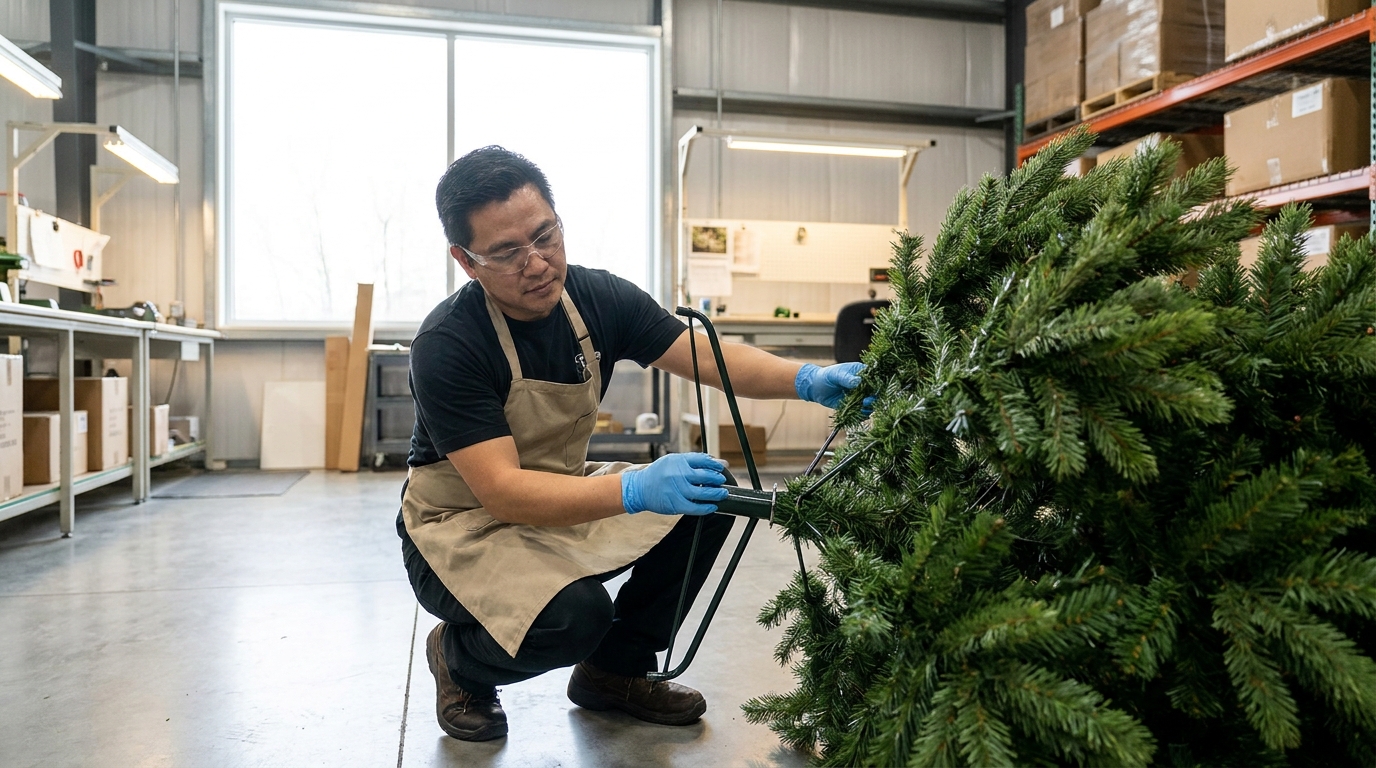
Photographs are helpful, but an artificial Christmas tree is a tactile product. You want to feel the tip density, check the stand, count the branches and set the tree up yourself before you commit to a container.
Most factories are happy to send samples. You will usually pay for the sample and the courier cost, and many suppliers will credit that back against your first order. Allow one to two weeks for a sample to reach you by air. When it arrives, assemble it exactly as your customer would. Time the setup. Look at the box artwork, the instructions and the way the sections are packed, because your customer sees all of that too.
MOQ and pricing, explained simply
MOQ means minimum order quantity, the smallest volume a factory will produce for one model. For artificial Christmas trees it is often quoted per model or per container. A common starting point is around 200 to 500 pieces per model, or simply one full 20ft container mixed across a few models. Factories set MOQs because each production run involves setting up materials, colours and tooling, so the number reflects what makes a run practical rather than any reluctance to work with smaller buyers.
Pricing moves with volume, specification and season. A basic 6ft PVC tree costs far less than a pre-lit 7ft PE tree, and ordering early in the year usually secures better terms than ordering in August. Always ask for a full quotation that states the model, size, tip count, packing details and validity period, so you are comparing like with like.
Incoterms without the jargon
Incoterms describe who handles which part of the journey. Three cover almost every tree shipment.
- EXW (Ex Works): you collect the goods at the factory door and handle everything from there. Best for buyers who already have a freight forwarder and consolidation plan in China.
- FOB (Free on Board): the factory delivers the goods onto the vessel at a Chinese port, typically Guangzhou, Shenzhen or Ningbo, and you arrange the sea freight and everything after. This is the most common choice for first-time importers because the split of responsibility is clean.
- CIF (Cost, Insurance and Freight): the supplier also arranges sea freight and insurance to your destination port. You take over from the port onwards. This suits buyers who prefer one invoice and less coordination.
Many suppliers now go a step further and offer delivered pricing, where the trees arrive at your warehouse with shipping already included. For a first order, that simplicity is worth a great deal.
Containers and consolidation
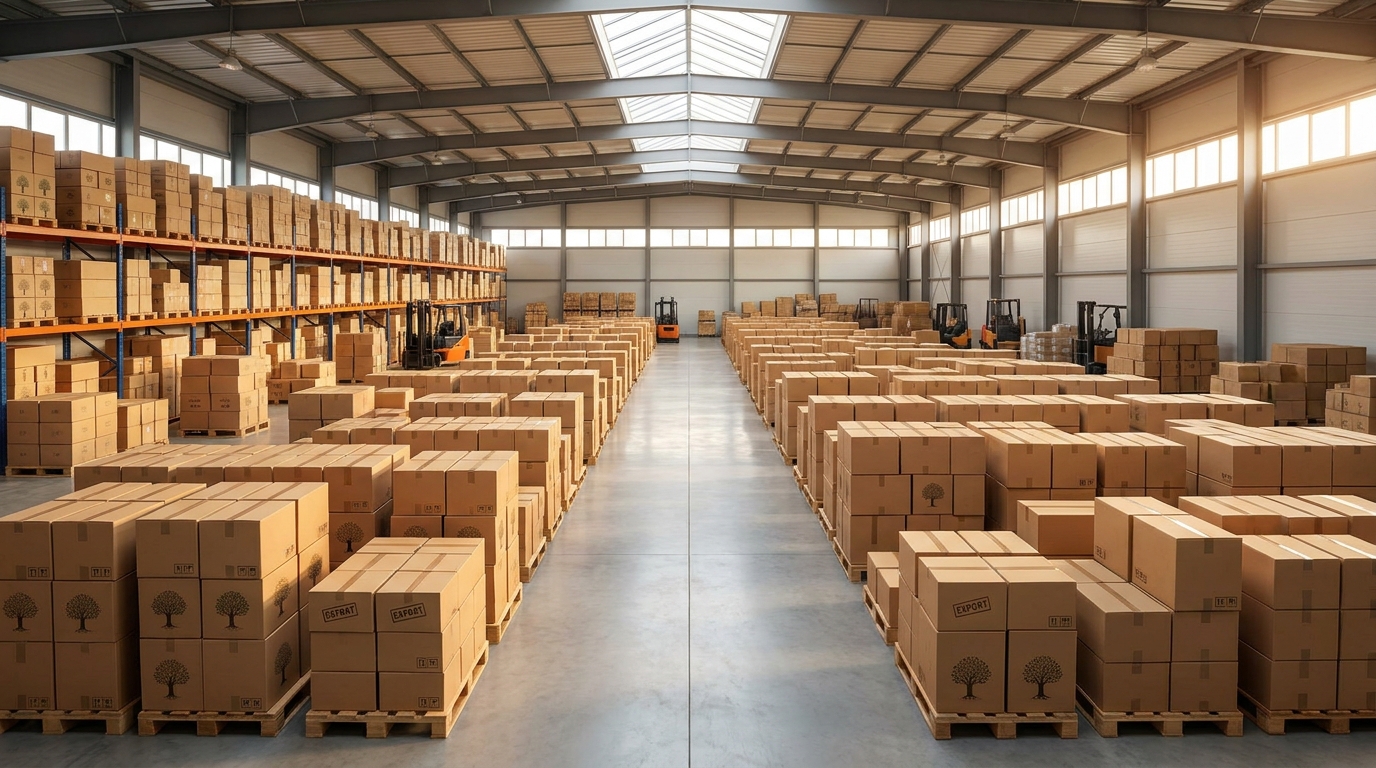
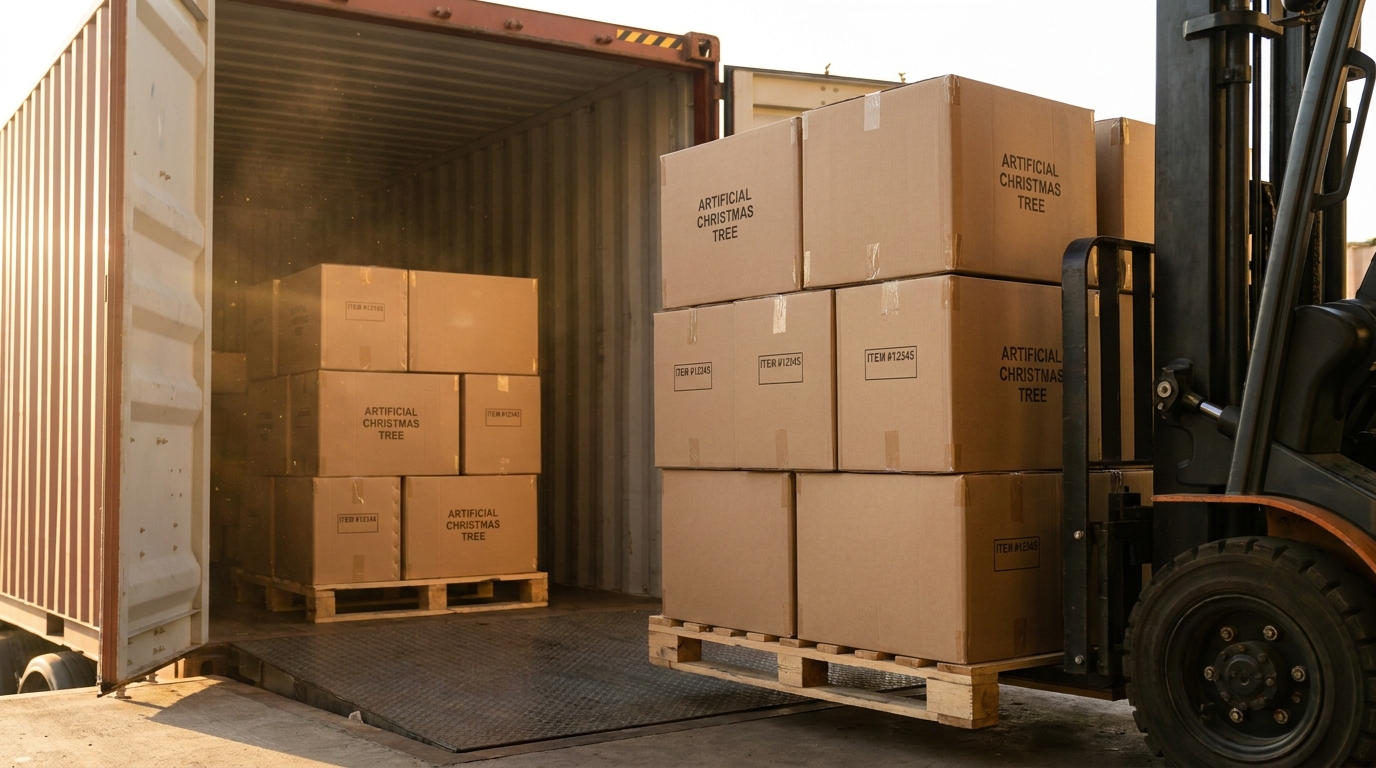
Trees are bulky rather than heavy, so container space is your real budget line. As a rough guide, a 20ft container holds around 350 to 500 boxed 6ft trees, and a 40ft high cube holds roughly 900 to 1,200, depending on the model and packing. Slim trees pack tighter, wide-girth and pre-lit trees take more room.
If you cannot fill a container with one model, mix it. Most factories load several models and sizes into a single container without fuss. And if you want trees alongside wreaths, garlands or ornaments from different suppliers, consolidation is the answer. Your forwarder or your main supplier collects goods from each source into one warehouse, then loads a single container. It adds a few days but saves meaningfully on freight.
Payment terms in plain language
The standard arrangement is a deposit and balance structure, usually 30 per cent deposit when the order is confirmed and 70 per cent balance when the goods are ready or against the shipping documents. The deposit lets the factory buy materials for your run, and the balance timing gives you a chance to inspect before the goods sail. Bank transfer is the norm. As trust builds over a season or two, terms often become more flexible.
Order in spring, inspect in summer, ship by early autumn, sell in winter. Keep to that rhythm and importing artificial Christmas trees becomes one of the calmest parts of your year.
The season calendar
Christmas trees run on an unusual clock. Factories quote and sample from January to March, take the bulk of orders from March to June, and produce through the summer. Lead time is typically 45 to 75 days after deposit, longer in peak season. Sea freight adds another 25 to 40 days depending on your port. Working backwards, an order confirmed by May sails comfortably in August and lands well before your shelves need filling. Book a pre-shipment quality inspection for the week the goods are finished, either through your supplier, a third-party agency or your own visit, and you sail with confidence.
Take it one step at a time, ask plenty of questions, and let the calendar guide you. Your first container is the hardest one. Every order after that gets easier.
Ready to price your Christmas range?
We are a Guangzhou factory partner. Send your sizes and quantities and we will quote you, delivery included.