Custom and private label Christmas trees: building your own range
Walk down the seasonal aisle of any good retailer and you will notice something. The trees that sell best are rarely the generic ones. They are the ones with a name on the box, a consistent look across the range, and a sense that someone thought about every detail from the tip style to the insert inside the carton. That is the power of a private label range, and it is far more achievable than most growing brands assume. If you can write a clear brief and approve a sample, a factory partner can handle the rest. Here is how retailers and brands build their own range of artificial Christmas trees, from the first size decision to the finished branded carton leaving Guangzhou.
Why build your own range at all
Buying stock designs from a catalogue is a perfectly good way to start. Many of our customers began exactly that way. But once a brand has a few seasons of sales data, its own range starts to make commercial sense. You control the specification, so you decide where the quality sits and where the price lands. You control the look, so your trees feel like yours rather than the same model your competitor carries. And you control the packaging, so every carton on the shelf works as advertising for your name.
Private label also protects margin. When the product is unique to you, customers compare it on its own merits. For a brand that plans to be around in five years, that matters.
Start with sizes and tip styles
Every range begins with two decisions: which heights to offer and what the branches should look like.
Choosing your heights
Most successful ranges cover three to five sizes. A common ladder is 150cm, 180cm, 210cm and 240cm, which serves flats, family homes and larger spaces. Some brands add a 90cm or 120cm tabletop model as an entry point, and a 300cm showpiece for commercial buyers. Custom sizes outside these standards are entirely possible, since the factory builds the metal frame and cuts the branches to your drawing rather than pulling from a fixed mould.
PE, PVC, or a blend
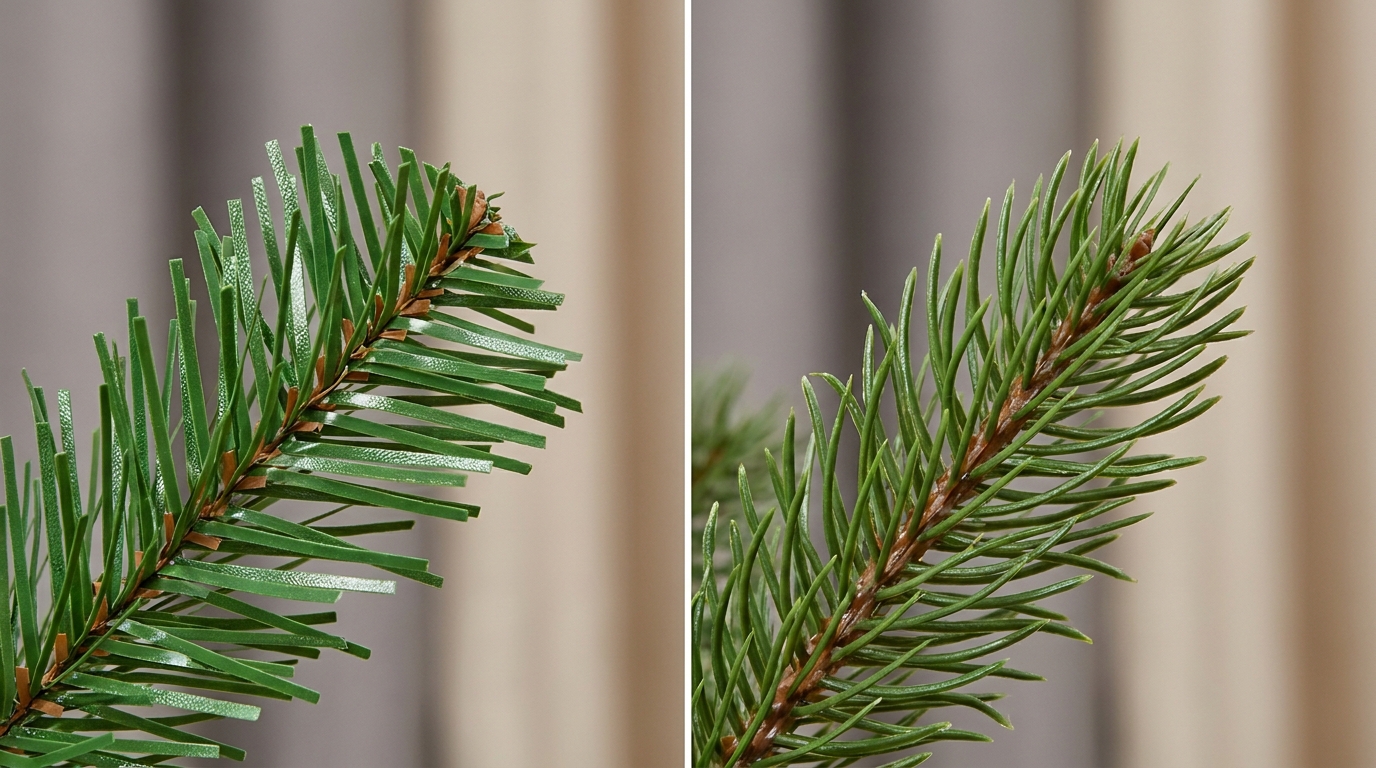
Tip style shapes both the look and the cost of the tree. PVC tips are flat needles cut from film, full and generous, and they keep the price accessible. PE tips are injection moulded from real branch impressions, so each needle has the shape and depth of a living conifer. Most premium ranges use a blend, with PE tips on the outer layer where the eye lands and PVC filling the interior for density. Tip count is the other lever. A 180cm tree might carry anywhere from 800 to 2000 tips depending on how full you want it, and your factory partner can build samples at two or three counts so you can judge the fullness in person rather than on paper.
Flocking, pre-lit LED and custom colours
Once the base tree is defined, the finish options let each model in your range earn its place.
- Flocking. A snow effect applied to the tips, from a light dusting on the branch ends to a heavy coat across the whole tree. Flocked models photograph beautifully and often anchor the premium end of a range.
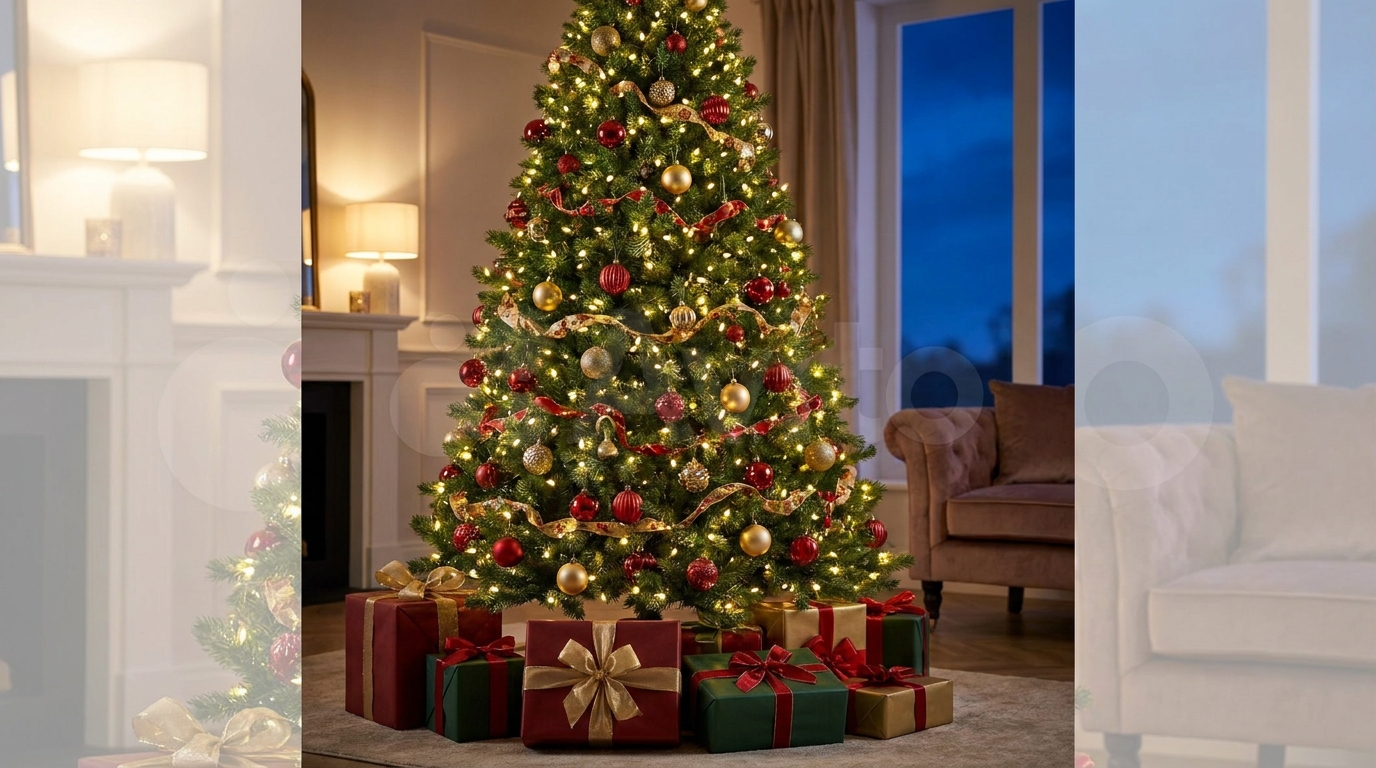
- Pre-lit LED. Lights fitted and wired at the factory, with warm white the most popular choice by a wide margin. You specify bulb count, plug type for your market, and whether you want steady, twinkle or multi-function controllers. Pre-lit trees carry a higher retail price and save your customer an evening of untangling.
- Custom colours. Classic green comes in many shades, and beyond it sit white, black, pink, champagne gold and two-tone effects. A colour tree is a strong way to give a range personality, and because the PVC film and PE moulding are coloured to order, you are not limited to what happens to be in stock.
Packaging, barcodes and inserts
This is where private label really shows. Your trees ship in your own colour box, printed to your artwork, with your logo, your lifestyle photography and your product copy. The factory prints your barcodes directly on the carton in the format your retail partners require, whether EAN or UPC, so goods scan straight into your systems on arrival. Inside the box, custom inserts do quiet but useful work: assembly instructions in your brand voice and your languages, a care leaflet, a warranty card, or a small piece inviting the customer to register the product or find your other ranges. None of this costs much at production volume, and it is the difference between a tree in a box and a branded product.
A brief becomes a range the moment the first sample arrives. Everything before that is words and drawings. Everything after it is refinement.
Sample approval, the step that makes everything safe
No custom order goes to production without a physical sample. The factory builds one complete tree to your specification, packs it in a proof of your carton where the artwork is ready, and ships it to you. You assemble it in your own showroom, check the fullness, the colour under your lighting, the stand, the hinges and the lights, then sign it off or request changes. Only when you approve does mass production begin, and the approved sample becomes the quality reference the whole order is checked against. It is a calm, methodical process, and it means the goods that arrive are the goods you expected.
MOQ and how a factory partner takes it from here
Custom work does need volume, though less than many brands fear. A typical MOQ for a fully custom tree with own-brand packaging sits around 200 to 500 pieces per model, depending on how much tooling and printing is involved. Lighter customisation, such as your packaging on an adapted stock design, can start lower still, which makes it a sensible first step into OEM.
From there the process is straightforward. You send the brief, even a rough one. The factory returns a detailed specification sheet covering height, tip count, PE and PVC mix, lighting, flocking, stand, carton dimensions and price. You refine it together, approve the sample, and production runs on an agreed schedule, usually with goods ready for the pre-season shipping window. With delivery included, the landed cost is known from day one, and your first branded range arrives ready for the shelf. Season by season you add models, adjust specifications based on what sold, and the range grows with you. That is how a brand gets built, one well-made tree at a time.
Ready to price your Christmas range?
We are a Guangzhou factory partner. Send your sizes and quantities and we will quote you, delivery included.